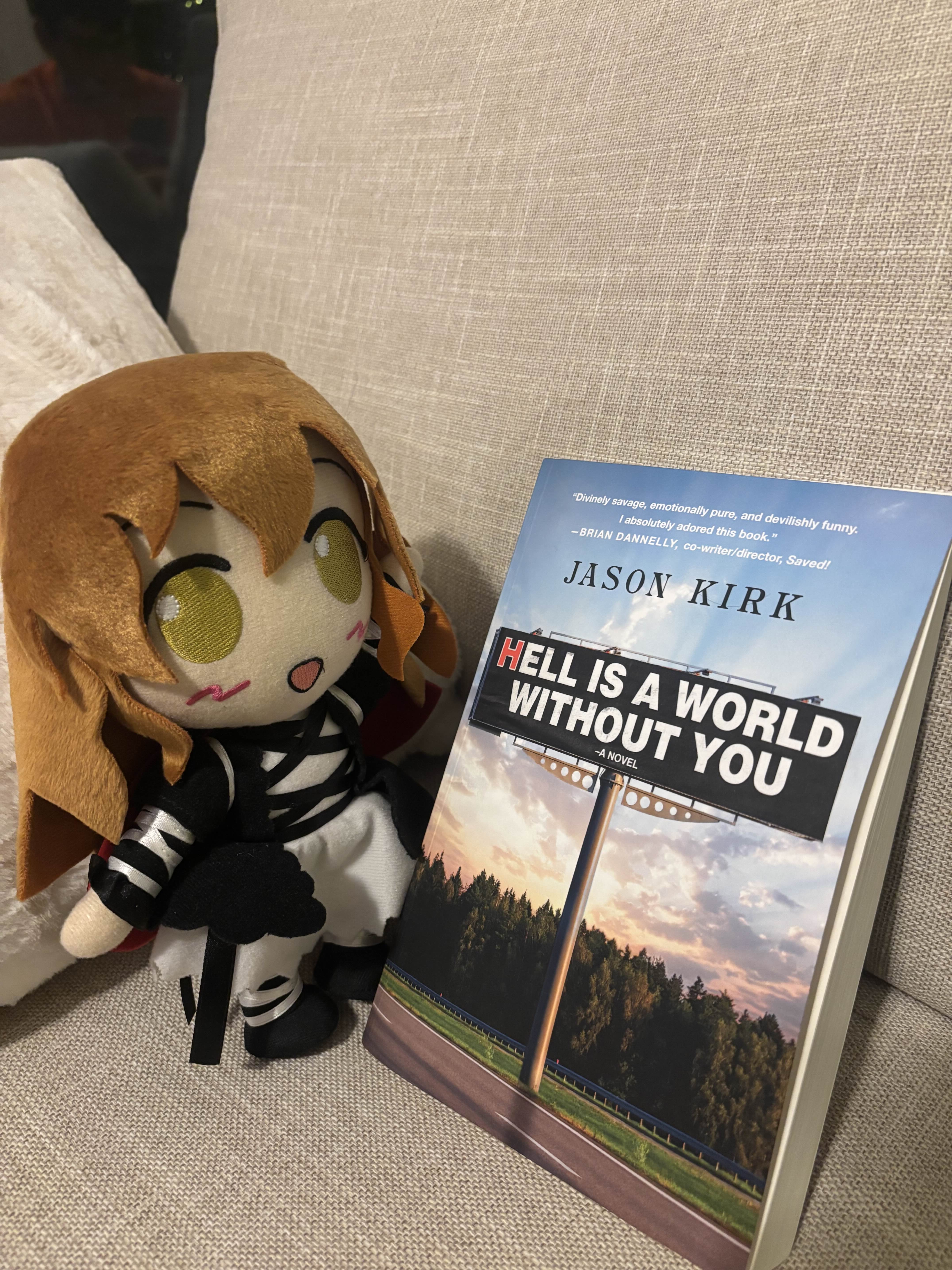
The world Isaac Siena, Jr. lives in at the start of Hell Is a World Without You is one where the doctrine of fear rules. This fear imparts itself into Isaac on several scales. First, the outwardly expressed views of the megachurch-industrial complex that formed the backbone of community in his formative years itself dictated that one must fit the mold of the ideal member of their in-group only ever identified as "Christian" to make it into Heaven when the Rapture comes, which you accomplish by remaining in the reality the pastor constructs. In this constructed reality, "Christians" are framed as being infinitely weak and constantly under attack from everyone else, yet infinitely strong with the ability to "save" these out-groups by forcibly converting them with zero effort required. Isaac's older brother, Eli, had been a true believeer in this church for a long time, first instilled by adults from the church pulling guns on him telling him to blashpheme or die (inspired by a an anecdote from the author's real life); parlayed into the belief that their father's death in a car accident was deserved and that he is burning in hell as a result.
How Isaac feels about all of this throughout the story is charted by a constant struggle to keep his internal monologue both "internal" and "a monologue". When he finally takes his first steps into the outside world through the avenue of public high school, he starts to identify all the internal contradictions of what Pastor Jack and his associates have been feeding him. A bold booming voice in Isaac's head intervenes to tell him that he will regret paying any mind to these contradictions. When Isaac attempts to heed that advice and do some proselytizing at his new school, the constructed reality starts to crumble further as he realizes that individuals in nearly every out-group his church has demonized are just ordinary people trying to live their lives; from Bobbi the atheist to Amir the Sikh (that unfortunately gets profiled as a radical Islamist in the wake of 9/11) and all inbetween. Pastor Jack, fancying himself as an architect of this reality, fails to accept the cracks in his very own foundation caused by his son Josiah being gay and his niece Sophie's desire to break free from the possibility of life as a Handmaiden; choosing instead to punish Isaac for sticking up for them.
Isaac eventually realizes the ties that bind him and his cohort together is a disillusionment with the Christian Nationalist doctrine of fear that is starting to creep into their lives even outside the megachurch walls. They assemble their own communion bestowed with the moniker "Video Games Church", where they can discuss their coming-of-age amongst each other freely. Eli, ever watchful, fears that Video Games Church is a cadre that can build a dual power structure that will threaten his program to maximize the "salvation" of others on his defined terms, no matter the cost. Isaac, Sophie, and the rest of the crew will respond to that assertion with "this but unironically" in turn.
Ahead of their senior year, Isaac and Sophie get together, not just as romantic partners, but with a clarity of purpose for a new thing to preach. Upon analyzing all the contraditions that have been laid bare before them, they choose to square them by preaching universal forgiveness. The first example Sophie cites (and the author's preferred one) is the third century Saint Origen of Alexandria, who theorized that on a long enough timescale, everyone will make up their mind and choose the path towards redemption. This parallels the closing arguments of the speech Martin Luther King Jr gave on the steps of the Alabama State Capitol: the moral arc of the universe will bend towards justice for all. Incidentally, Isaac and Sophie's praxis is backed by theory that includes quotes MLK said that aren't brought up when the sanitized version of him is presented; that religions that refuse to acknowledge the material conditions of the souls they claim to oversee are spiritually moribund. The explicitly anti-capitalist bent they take on is just as radical to society writ large as the idea that hell is empty is to the fire-and-brimstone-industrial complex they came from.
The central conflict of Hell Is a World Without You consists of the same battle lines as the overarching ideological war of our times: should our society be structured around hatred for one another, or for compassion? Isaac, Sophie, and the rest of their cadre have planted themselves firmly on the side of compassion; they are set up to challenge Eli and Pastor Jack's orthodoxy of hatred. The final confrontation of the book shows these two sides' ideal approach to building influence: Isaac is armed with theory and mutual aid, while Eli is literally armed. With a gun. In Eli's world, this gun gives him the authority to determine which lives matter and which lives do not. In Isaac's world, our world, it is love and solidarity that rule the day. Indeed, when Eli fires his gun, Isaac survives because the community he has built; Best Caleb is able to physically assault Eli and mess with his aim.
This story needed to be told, not only because it identifies the battle lines of the biggest question facing the 21st century world, but also for its look into life inside the walls of one of the key players on team hatred: America's Christian Nationalist movement. The book keeps a keen eye on the leading figures of this right-wing fundamentalist movemen. Among these, the most attention is given to James Dobson, who "earned" the ignominy of being the absolute last person Isaac thought about forgiving by making it his life goal to prescribe corporal punishment to as many children as possible for doing things he didn't like. There is a direct throughline from how Dobson thought households ought to be ran to how Donald Trump thinks nation-states ought to be ran: the Trump Doctrine is defined by declaring war on places that do things he doesn't like.
Other works have defined these battle lines in the past, often offering a much more blunt assessment of the situation. The one that has stuck with me the most in the years since it was recorded was Matt Christman's explanation of the material reality that lies ahead of us in the wake of the deadly Unite the Right rally in 2017: society writ large must choose between mass redistribution of the ill-gotten gains of the First World (team compassion) or genocide (team hatred), and that the Unite the Right rally represents team hatred openly professing their desire for genocide. Isaac Sienna, Jr's salvation testimony that forms the epilogue of this book offers a much more hopeful case for team compassion: everything him and Kori (formerly known as "Sophie") has done was to show the disaffected that a better world is possible and that nobody can tell you that you can't be yourself.