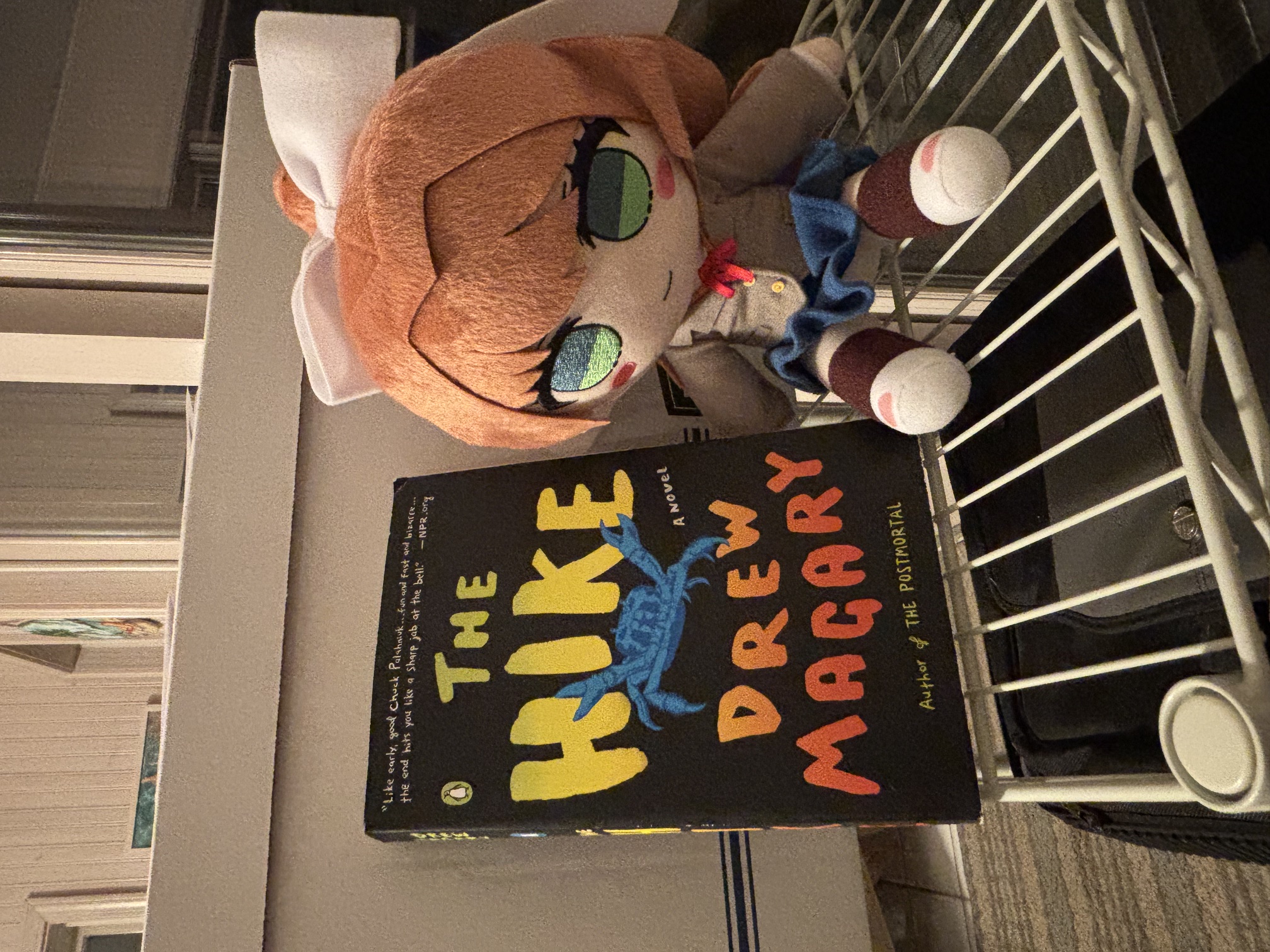
Now that a trope has been commented on, subsequent writers can now play with the concept when storyboarding. You are probably familiar with the story that George Lucas intentionally invoked The Hero's Journey when storyboarding Luke Skywalker's character arc in the original Star Wars trilogy. Closer to the present day, Drew Magary sits down at a dask with a typewriter and a bare lamppost. The lampshade he decides to hang is that "Hero's Journey" infographic that educators love to use annotated with notes about how to parody the concept as opposed to playing it straight. This is, in broad strokes, the genesis of The Hike and Ben's character arc within.
Ben, an unassuming salaryman, has his call to adventure into the unknown come in the form of tire tracks that extend past the officially marked end of a hiking trail behind the hotel he's staying at. If the initial run-in with dog-faced attackers didn't clue Ben into the fact that getting back to the known won't be easy, an ominious piece of stationary in a tent does the trick (emphasis mine):
Stay on the path, or you will die.
"The path" and references to it are the arc words of this book. There are layers to this phrase. First off, the path and its associated trials can be likened to The Hero's Journey. Additionally, the path may as well extend indefinitely from Ben's point of view as he goes through it, so comparisons to the path towards escaping the endless cycle of death and rebirth are appropriate. What lies at the end of this cycle? A run-in with an enigmatic "Producer". The presence of a Producer figure ties these layers full circle, both as an analogue to the divine intervention that drives stories from classical mythology and to the present-day jobs driving the production of shows and films.
The choice of a crab as the most irreverent of Ben's mentor/companion figures on this hike seems to have come out of left field at first glance. The reveal that Crab is Ben from a point further along the path (which we do eventually end up seeing for ourselves) is a nod to carcinisation, the phenomenon that all shellfish will eventually undergo convergent evolution towards being a crab. Not only does this poke fun at the idea that all stories can be boiled down to the same beats, it opens up the possibility that the world Ben is travelling through exists outside of time as classic stories do. This sets up a practical application of this thesis when Ben's path intersects with rising conquistador Cisco's. In addition to good chemistry, this crossover arc leads itself to a tinge of societal commentary placed within the ongoing commentary on storytelling: the "new world" is Cisco's unknown (on the path) and Ben's known (escape from the path).
Ben appropriately faces many different trials on the path. The Hike makes it a point in its selection of trails for Ben to surmount that there's more to adventuring than being what is derogatorily known as being a "murder hobo", even if the biggest challenge along the way is to kill the big bad evil guy you were stuck doing manual labor for. Or the fact that you are armed the whole time. Likewise, the temptations that could lead Ben off the path are based in his own personal memories and/or fetishes.