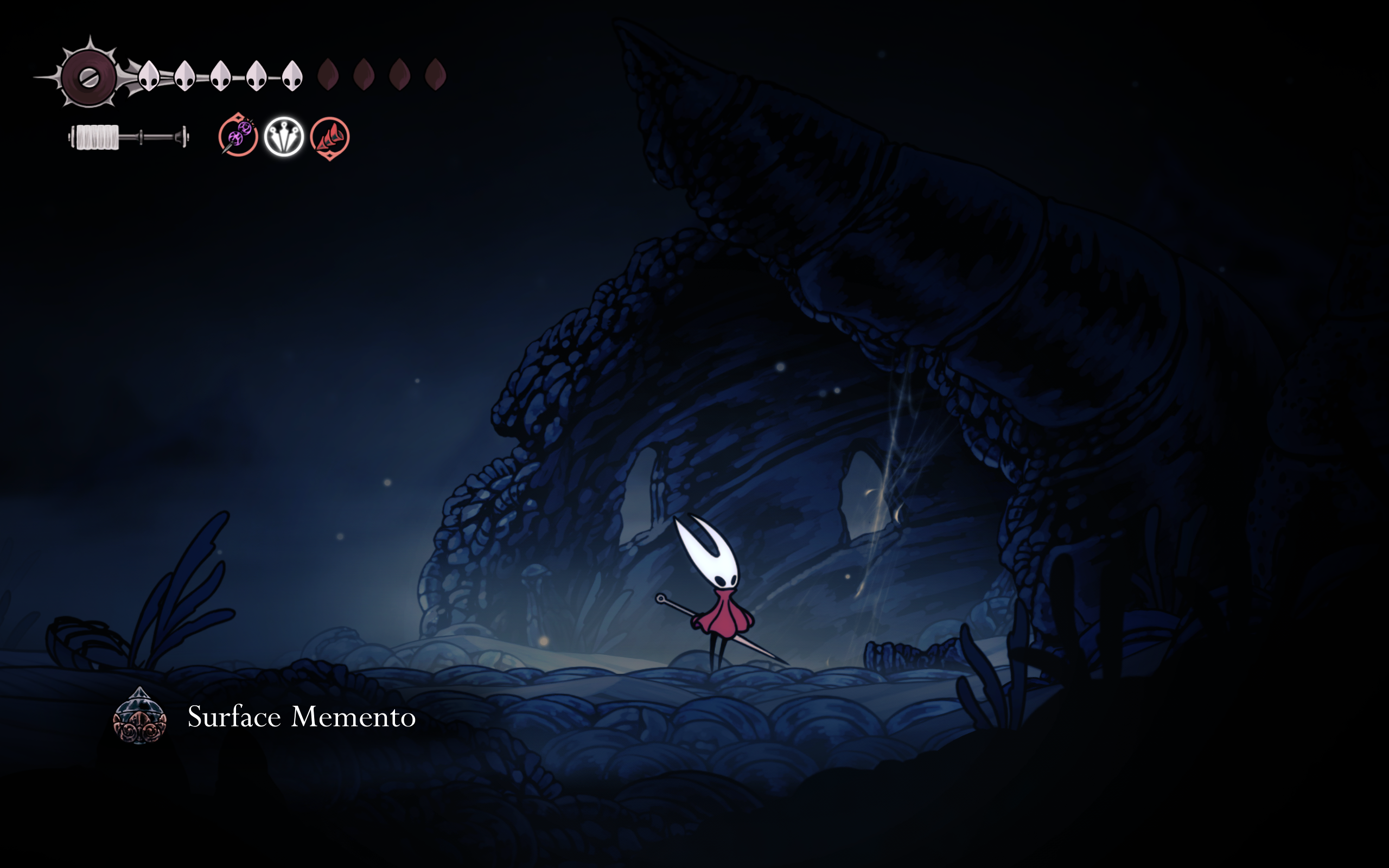
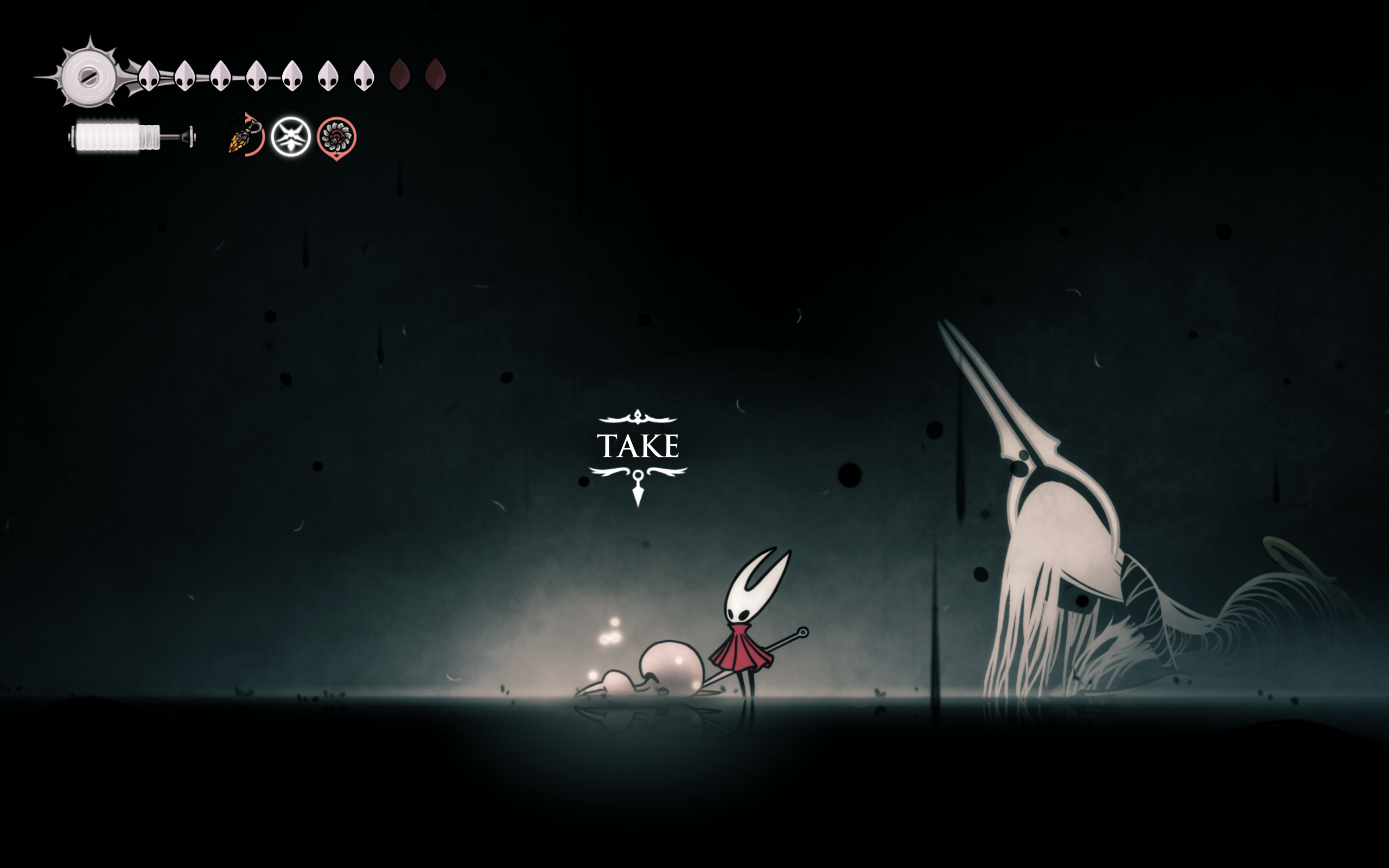
WARNING: major spoilers for Silksong's Act 3 ending(s) and Godmaster content for the original Hollow Knight are included in this post. If you do not wish to be spoiled for either of these things, turn away now.
Team Cherry's long-anticipated follow-up to Hollow Knight more than lives up to its billing by building on its predecessor in every way. This is most readily apparent in the sheer expansion of the amount of ways skill expression is offered to the player. Hornet's added mobility options make piloting her a much more fluid experience than piloting the Knight. The Crests offer a set of very distinct playstyles, and the Tools and Silk Skills comprise a suite of readily available and practical tech applications for combat and platforming scenarios. I mainly stuck with the Reaper crest, leaning heavily on the vertical pogo for movement and being able to move and capture orbs of silk for being able to more frequently Bind and use Silk Skills for combat.[1]
As the game's general difficulty curve might signal, adaptation is the name of the game. I found the various combat gauntlets exemplary in this regard, waves of diverse groups of enemies in each locale provide a great backdrop to tinker with your loadouts. Have a good grasp of where and how enemies spawn in? Try setting some traps. Annoyed by armored enemies? There are tools (and Silk Skills) to bypass that. You may even find opportune times to swap off your main crest. I swapped to Beast for gauntlets where certain enemies were placed in such a way that it would be easier to heal by just hitting them as opposed to chasing orbs, and Architect for boss fights where you would really want a third red tool (like Cogflys or Plasmium vials).
That being said, there are plenty of challenges where the thing you must adjust isn't your loadoat, it's your behavior. Each of the marquee platforming challenges such as the initial ascent of Mount Fay, the initial escape from the Abyss, and exploring the surface all compel you to rewire how you use your available movement techniques to complete them. Duel-style bosses, such as the three Lace fights, demand you play footsies. They will whiff punish you, anti-air you, and use defensive techniques to take their turns back. The easiest way to beat them is to return the favor.[2]
The Art of the Runback
In Silksong, much like real life, all the planning in the world goes away once you get punched in the mouth. The fake-out victory trope is used frequently enough and in varied ways during gauntlets and/or boss fights that the player is on edge looking for what the next one might do.[3] What I (and certainly others too) tried to prevent from happening during combat were checkmate scenarios where wherever you go, you can't avoid all potential fatal blows. When Void Masses start appearing on the map during Act 3, the amount of screens this could happen in grows significantly.
The simplest solution to this conundrum is to simply be better in the leadup to the group of enemies or boss phase that can cause this scenario. The most common difficulty complaint, the lengthy runbacks (ie: Hunter's March, Bilewater), serve to reinforce this mindset. I have always had appreciation for the craft that goes into speedrunning: constantly putting in attempts of the same games and strategies over and over again to achieve their goal, oftentimes having plenty of opportunities to recover if one underperforms in a given segment/split. Team Cherry has always excelled at exporting this gameplay loop to even casual playthroughs; they ensure that when you are done with "the run" that makes it to the goal you were pursuing, you are treated to an exclamation mark.[4]
On top of the world...
Does This Look Incomplete to You?
One thing I enjoy quite a lot about open-world games of all types that often goes unstated is that you have a say in how much you want to complete in order to be satisfied with your experience. When playing open-world games, my MO is to explore as much as I can blind while working my way through the game. Silksong adheres to the Metroidvania genre conventions that help in this regard, separating the world into distinct areas with their own maps. Each time I boot up the game, I pick a direction from where I left off and go that way until either I or the game decides it's best for me to go a different way. Silksong's three-act structure affirmed this playstyle, I cleaned-up each of the areas I went through on my way to completing Act 1 by beating the Last Judge[5] and subsequently went through fighting every boss and collecting every technique accessible to me on the way towards completing only the Snared Silk ending of Act 2 to access Act 3.
An observation (not neccssarily a complaint) others have had regarding the structure and pacing of Act 3 is that it was made with the constraints of trying to integrate otherwise cut content along with not wanting any collectibles from the previous acts to be permanently missable. While the fear of missing anything did somewhat inform the decision to go full mop-up duty mode at the end of Act 2, I didn't feel hamstrung by any of the content I could've done but decided to save for Act 3. Team Cherry acknowledges completionist tendencies in-game by hiding the ability to view a save file's completion percentage behind a item that players may have missed during their first trip to the Abyss.
After collecting all four Old Hearts and traversing the Red Memory, I was at a crossroads to determine what extra things to do before diving down to face the true last boss. At the time I unlocked the path to the true ending in Hollow Knight, I was fully pot comitted to maximizing the amount of things in the game to see (time and difficulty permitting) that I was compelled to scratch some of the game's unreachable itches (ie: delivering the Delicate Flower and killing the Menderbug) ahead of challenging the Radiance. Fitting with the core themes of the game, Silksong's content that is meaningful to me (ie: platforming and combat challenges) is contained within the "good deeds" that put you on the path to unlocking Act 3 in the first place. With this in mind, I identified the last remaining challenges ahead of the last boss that were meaningful to me to include following Mister Mushroom up to the surface and completing the Hunter's Journal.
This decision ended up touching on a core aspect of my process of enjoying Metroidvanias and other open-world genres in the first place: visiting the entire map from top to bottom,[6] including finding hidden areas where unique enemies can be found and fought. Upon making the last dive, I was treated to a satisfying mastery check of a last boss in Lost Lace. She empties the game's combat playbook in a frenetic four phase fight, something I had to wait for post-game superbosses such as Nightmare King Grimm and the Pure Vessel[7] in Hollow Knight. With this satisfying ending in hand, my verdict is that I was hooked start to finish in an experience that touches on most of the things I enjoy in single-player games.